Image for banner reproduced by permission from the President and Fellows of Queens' College, Cambridge. [Psalm 23 in Syriac. Psalmi Davidis, edited by Thomas van Erpe (Leiden 1625)]

Saturday, October 22, 2011

Bart Ehrman and the authenticity of Scripture

Mike Heiser, Bibilical scholar, writes concerning Bart Ehrman:

My contention with Bart is that he’s a fundamentalist — someone who is unwilling to process an issue in any other way than the black-and-white, either-or fallacy that he himself has framed. I’m sympathetic to him only in the sense that some acute personal suffering appears to be behind his fundamentalism. While I wish there was something I could do to help in that regard, I also have to be honest and say that it seems quite clear that Bart’s personal pain has skewered his scholarship. He’s human.

My greater irritation is the way the masses (aided and abetted by a pathologically ignorant media) swallow whatever Bart says as though its some grand, now self-evident discovery, or think that no one can be looking at the same data and still believe in the reality of the Christ of the gospels. Wrong on both counts. There are many scholars who do what Bart does (textual criticism, New Testament studies) who draw conclusions contrary to Ehrman’s and, more importantly, are capable of judging his method and scholarship.


To illustrate this point regarding Bart Ehrman and popular culture Heiser discusses a recent topic in textual research; whether or not the phrase "Son of God" originally appeared in Mark's Gospel, the oldest New Testament book. Ehrman typically argues that the authentic texts of the early Christians did not describe Christ in divine terms, and any descriptions of Christ as being divine (phrases such as "Son of God" etc) were added by later generations by "orthodox" scribes who sought to alter scripture in order to make it support their newer, inauthentic, paternalistic theology.

Textual critic Tommy Wasserman takes quite a different stance. I had originally stated that Wasserman showed there is far more historical and manuscript evidence to support traditionally accepted view. This however would not be the most faithful explanation of his point. It would be more accurate to say the balance of probabilities is in favor of the long reading. Thank you to Dr. Wasserman for pointing this out to me. I recommend reading Dr. Wasserman's paper. It can be downloaded here: 

www.orebromissionsskola.se/personal/wasserman 
(scroll down to the article on Mark 1:1).

With this object lesson in mind, Mike Heiser continues:

... the issue is that there is more than one way to look at New Testament manuscript data. Ehrman isn’t discovering something new and unknown to scholars. He isn’t putting forth unassailable arguments that make the faithful run for the hills. He’s arguing his position based on how he sifts the data — i.e., his views are simply interpretations, nothing more — and other professionals in his own field might conclude other interpretations are more reasonable.

Entire article here:
http://michaelsheiser.com/TheNakedBible/2011/10/bart-ehrman-vs-the-son-of-god-in-mark-11-a-response/

Saturday, September 17, 2011

Free online class in Biblical Hebrew


Saint Stylianos Orthodox Children’s Charities Inc. in Clarkesville, GA is sponsoring an online class in Biblical Hebrew. The class is free and takes place Friday evenings 6:00 PM Central Standard Time. It began on October 1st and will continue once weekly for two hours per week, for twelve weeks total. To join the Intro to Biblical Hebrew class, sign up here:

http://ststylianos.org/learning/

The director of the class plans to offer a Syriac course (with tuition) in the future.

Friday, September 9, 2011

Oxford helps you get experience transcribing ancient manuscripts

Between 1897 and 1907, seven hundred boxes of papyri were discovered on the site of the ancient city of Oxyrhynchus and shipped to the University of Oxford. To date only a small percentage of the "Oxyrhynchus Papyri" has been edited by scholars. Lack of personnel and funds means that about two million segments of ancient papyri are still waiting to be studied, or even read, for the first time.

The task is too big for the Oxford research team so people across the world are invited to help translate the ancient documents. The ingenious part is that no knowledge of classical Greek is required. About 200,000 segments of the ancient Oxyrhynchus papyri have been uploaded to www.ancientlives.org and using character-recognition tools you can assist in the transcription process. Oxford has developed software that allows users to match Greek letters with the symbols on the papyri. The software then translate the words and stores them on a searchable database.

Read about project at Ancientlives.org or get started now by going directly to the transcription tutorial here: http://www.ancientlives.org/tutorial/transcribe

Friday, August 19, 2011

The world’s earliest question mark???


Owner of Jericho Press and author of Robinson's Paradigms and Exercises in Syriac Grammar, Dr. Chip Coakley has identified what may be the world’s earliest example of a question mark...

Manuscripts of the Bible are not even the majority of the collection now in the British Library, but they have their special points of interest. One of these is the way that the graceful and flowing Syriac script is peppered with dots. 
 
Some of these dots are well understood, but some are not – some, indeed, probably not even by the scribes, who did not copy them consistently. All this made for a confusing picture, and it needed a patient scholar to start to make sense of it.
 

Saturday, August 13, 2011

Antiochians Participate in Cambridge Institute's Summer Session

The Institute for Orthodox Christian Studies in Cambridge, England, recently wrapped up its 12th annual Summer School session, titled "The Challenge of a Secular Age." (Read Principal David Frost's summary of the week.) The Institute has close ties with the Antiochian Deanery in the United Kingdom, and Antiochian Orthodox Christians from North America have also participated in this distance learning program. Some have even been able to travel to England to attend the summer sessions. 

Dr. Michael Basham, an Antiochian member of the Institute's Board and a Parish Council member of St. Luke Antiochian Orthodox Church in Erie, CO.: "We strive to raise our intellectual awareness while deepening our spiritual growth and in doing so be able to '...confront life’s problems without fear or anger.' "

To assist individuals and parishes do that, Basham explains, the Institute provides a number of resources. "At St. Luke we have used the Institute's resource THE WAY... The distance learning program in Orthodox Christian Studies has been truly transformative for me and I would encourage everyone to experience the Institute for themselves by exploring their online library which features video recordings from worship events, lectures, recitals and interviews with world-class Orthodox scholars and spiritual leaders.”

Saturday, July 23, 2011

I beheld the Codex Climaci Rescriptus with mine own eyes

As most of the Biblioverse knows, the Codex Climaci Rescriptus was purchased by Steven Green, owner of Hobby Lobby, and placed within a larger collection entitled Passages which is currently on the first leg of its tour in Oklahoma City.

I am not sure what I expected, but I thought perhaps I would see the codex highlighted and surrounded by a few other items shown on the Passages website.  This was not the case. Whether by lack of marketing were whether by intentional understatement, the extent and quality of the collection is both surprising and overwhelming to the degree that the Codex Climaci Rescriptus is almost swallowed up.

The one weakness of this exhibit is that there was no master list of display items. Had this been available I think the collection would have made a bigger splash; not necessarily for you academic types, but moreso for local pastors and knowledgable lay people who are aware of manuscript, translation, and printing history but have seen historical items only as photos in textbooks or on the internet. It is wonderful to find a high resolution scan of an ancient codex, but it is another thing altogether to read words on the living page.

In the absence of an official exhibit list, I offer here my own incomplete and hastily written list of items on display at the Passages exhibit. Judge for yourself whether the Codex Climaci has found a worthy home. But be aware, my list represents only about a third of the actual exhibit...

"Evanis" Gospel illumination
  • Circular menorah hewn from a single stone. Most likely used in the 2nd temple, according to the display.
  • Multiple medieval Torah scrolls- Yemenite, Sephardic
  • Dead Sea Scroll fragment (was not able to get detail, maybe later)
  • Bodmer papyrus XXIV
  • Evanis Gospels, Greek, c. 1000.( illuminated on parchment. One of the earliest and smallest examples of calligraphic minuscule.)
  • Multiple Greek papyri- 2nd-5th centuries
  • Codex Climaci Rescriptus- only two leaves on display, one showing the underlying Greek text (with a handwritten "5" in the corner), the other showing the CPA palimpsest (the rest of the Codex is stored off site, in the possession of the Green family).

"St. Cecilia" Latin Bible
  • van Hattem Bible (Latin)
  • St. Cecilia Bible (Latin)
  • Several Vulgates from 1200s (handwritten margin notes in Latin visible :) )
  • Greek parchment "Letter from Theon", 3rd cent.
  • Coptic papyrus Psalms 112 (111 in Protestant/Masoretic reckoning), 4th cent.

  • Khabouris Codex, (open to show the Acts of the Apostles, ch 3) 11th cent.
  • Multiple medieval French and German Bibles & prayer books
  • Rosebery Rolle Bible
  • Anglo Saxon printed gospels 1573
  • Conveyance document (transfer of property title), signed by John Wycliffe's brother Robert and including his seal. 1393
  • 1454 Gutenberg "noble fragment" of Romans
    The Anti-Christ and 15 Signs of the Doomsday
  •  1462 Gutenberg Bible printed by apprentice Peter Schöffer, 1 of 4 surviving copies.
  • 1480 Latin Bible with papal seal, taken by Napoleon
  • The Anti-Christ and 15 Signs of the Doomsday (Der Antichrist und die fünfzehn Zeichen). Block-book. Nuremberg: Hans Sporer, 1470. Only surviving copy.


  • 1493 Nuremberg Chronicle
  • 1470 edition of "Antiquity of Jews and the Jewish Wars" by Josephus (Latin)
  • 1471 edition of "Postilla Litteralis super Bibliam" by Nicholas de Lyna
  • 1476 Venetian edition of "Summa Contra Gentiles" by Thomas Acquinas
  • "The Imitation of Christ" by Thomas a Kempis, 1st edition. c 1418.
  • Genoa Polyglot Psalms, 1516 (Greek, Aramaic, Hebrew, Latin, Arabic). Psalm 19 includes a margin reference to Christopher Columbus's voyage to the New World and the prophetic character the Gospel being carried around the world:  Et in fines mundi verba eorum, Saltem teporibus nostris ... mirabili ausu Christophori Columbi  genuensis, alter pene orbis repertus est christianoremus cetui aggregatus.

  • Johannes Frobens "Poor Man's Bible" 1491 (Latin)
  • Last Will and Testament, Martin Luther, Oct. 1518.
  • "Babylonian Captivity of the Church" by Martin Luther, 1520.
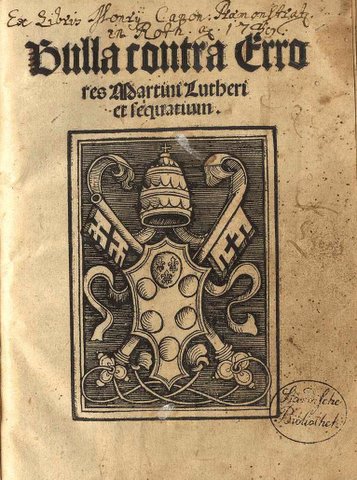
  • Papal Bull Condemning Martin Luther, Pope Leo X, 1520.
  • Papal Bull Condemning Martin Luther, Pope Adrian VI, 1523.
  • a 1525 indulgence
  • 1522 Erasmus' Commentary on his Latin paraphrase of the NT
  • 1516 Erasmus Greek NT (the one that was rushed to print)
  • 1521 Erasmus Greek NT
  • Complutensian Polyglot, Vol IV, NT (whose typeface begat some of our modern Greek PC fonts)
  • 1525 Daniel Bomberg Pentateuch (Hebrew text including Aramaic targum and Rabbinic commentary)
  • Martin Luther NT 1524 illustrated/painted/gilded
  • Tyndale Pentateuch 1530
  • Tyndale NT 1536
  • Coverdale Bible 1535
  • Coverdale NT English/Latin 1538
  • Taverner (Coverdale revision) 1539
  • Geneva NT 1557
  • Geneva Bible 1560
  • "Bishop's Bible" 1568
  • Rheims NT 1582
  • 1611 1st edition KJV
  • relief book cover by Salvador 
    Dali (click on photo to enlarge)
  • several KJV folio editions
  • Stephanus Greek NT 1551
  • multiple KJVs from 1600s
  • "Wife Beater" Bible 1551
  • "Child Killer" Bible 1795
  • "Wicked Bible" 1631
  • "Vinegar Bible" 1717
  • multiple illustrated and engraved Bibles.
  • 10th cent. Greek Psalter from Constantinople
  • Psalterium Gallicannus Ferriatum (?) 1420
  • Illustrated Psalter, Master of Jacques de Besancon 1480
  • Speculum Humanae Salvationis, 1370, Tyrol
  • Metal relief book cover by Salvador Dali for Sigmund Freud's Moïse et Monothéisme

Tuesday, July 5, 2011

New Testament Textual Criticism: The Case For Byzantine Priority


From the beginning of the modern critical era in the nineteenth century the Byzantine Textform has had a questionable reputation. Associated as it was with the faulty Textus Receptus editions which stemmed from Erasmus’ or Ximenes’ uncritical selection of a small number of late manuscripts (hereafter MSS), scholars in general have tended to label the Byzantine form of text “late and secondary,” due both to the relative age of the extant witnesses which provide the majority of its known support and to the internal quality of its readings as subjectively perceived. Yet even though the numerical base of the Byzantine Textform rests primarily among the late minuscules and uncials of the ninth century and later, the antiquity of that text reaches at least as far back as its predecessor exemplars of the late fourth and early fifth century...

The article was originally published online by SBL's TC: A Journal of Biblical Textual Criticism. The 1st Part can be read on the Preachers' Institute site here.

From Part II:
If a legitimate critique can be made against the Byzantine Textform because early witnesses fail to reflect its specific pattern of readings, the current eclectic models (regardless of edition) can be criticized more severely, since their resultant texts demonstrate a pattern of readings even less attested among the extant witnesses. Read Part II here.

Part III here...