Image for banner reproduced by permission from the President and Fellows of Queens' College, Cambridge. [Psalm 23 in Syriac. Psalmi Davidis, edited by Thomas van Erpe (Leiden 1625)]
Showing posts with label early christianity. Show all posts

Thursday, December 1, 2016

The Myth of the Pagan Origins of Christmas

"... the December 25th pagan feast of the “'Birth of the Unconquered Sun'… was almost certainly an attempt to create a pagan alternative to a date that was already of some significance of Roman Christians." 

The most detailed study of this is by Thomas Schmidt at Yale. As a scholar of ancient Greek he takes into account pre-Christian writers. Look in Academia.edu and Vigiliae Christianae
http://www.intellectualtakeout.org/blog/myth-pagan-origins-christmas 

Hippolytus in 202-211 AD set the date for the birth of Jesus on December 25, because he thought Jesus was conceived 9 months earlier on the Passover, the day in which he also thought the world was created (5500 years earlier), the Vernal Equinox March 25. Clement of Alexandria (193-215 AD) quoted various anonymous sources about the birth of Jesus and roughly agrees with Hippolytus, claiming that Jesus was born in late fall to early winter. Clement’s sources clearly seem to believe that Jesus was conceived on the Passover and was born roughly 9 months later; in fact the only difference between them and Hippolytus is that they differed on when the Passover actually occurred.

-by Tom Schmidt “Sol Invictus evidently not a precursor to Christmas” Chronicon Blog, December 21, 2010. (http://chronicon.net/blog/christmas/sol-invictus- evidently-not- a-precursor- to-christmas)

The following is from "Calculating Christmas” Touchstone Magazine, by William J. Tighe, Associate Professor of History, Muhlenberg College, Allentown, Pennsylvania:

As things actually happened, Aurelian, who ruled from 270 until his assassination in 275, was hostile to Christianity and appears to have promoted the establishment of the festival of the “Birth of the Unconquered Sun” as a device to unify the various pagan cults of the Roman Empire around a commemoration of the annual “rebirth” of the sun.

...the early Church followed [the Gospel of] John rather than the Synoptics, and thus believed that Christ’s death would have taken place on 14 Nisan, according to the Jewish lunar calendar. Greek Christians seem to have wanted to find a date equivalent to 14 Nisan in their own solar calendar... they chose the 14th day of Artemision [equivalent to April 6th on the Roman calendar]. In contrast, second-century Latin Christians in Rome and North Africa... concluded that he died on Friday, 25 March 29. So in the East we have April 6th, in the West, March 25th.

At this point, we have to introduce a belief that seems to have been widespread in Judaism at the time of Christ, but which, as it is nowhere taught in the Bible, has completely fallen from the awareness of Christians. The idea is that of the “integral age” of the great Jewish prophets: the idea that the prophets of Israel died on the same dates as their birth or conception.

The early Christians applied this idea to Jesus, so that March 25th and April 6th were not only the supposed dates of Christ’s death, but of his conception or birth as well...

What is the length of pregnancy? Nine months. Add nine months to March 25th and you get December 25th; add it to April 6th and you get January 6th. December 25th is Christmas, and January 6th is Epiphany.

Christmas (December 25th) is a feast of Western Christian origin. In Constantinople it appears to have been introduced in 379 or 380. From a sermon of St. John Chrysostom, at the time a renowned ascetic and preacher in his native Antioch, it appears that the feast was first celebrated there on 25 December 386. From these centers it spread throughout the Christian East, being adopted in Alexandria around 432 and in Jerusalem a century or more later.

Thus, December 25th as the date of the Christ’s birth appears to owe nothing whatsoever to pagan influences upon the practice of the Church during or after Constantine’s time.

Saturday, February 11, 2012

Fr. McGuckin hits another one out of the ballpark

This is tremendously exciting; The Ascent of Christian Law: Patristic and Byzantine Reformulations of Greco-Roman Attitudes in the Making of a Christian Civilization is a new publication that bridges the gap between Eastern Christian thought, Roman antiquity, and political science. Moreover the author is John McGuckin, probably unknown in poli sci circles, but well respected in the field of early Christianity and religious philosophy. Then why care? Then how is this relevant to political science?

Because one might notice that scholars from other fields seem to be making inroads into areas we would consider political science; that is, as historians, philosophers, Patristics scholars write within their fields, they explore the political implications of their respective areas of research. This is superb in my mind.

However one must ask the question; do we see the same kind of multidisciplinary interests on the part of political scientists? I am convinced that these other fields are valuable to political science but at the same time, someone from within the poli sci discipline could take such research even further.

Case in point: as I've read scholarly and pop-scholarly books on Christian origins, I frequently run across language that, I feel, is subtly political; language that in a historical context of the book itself would have little use, but when read by someone within our modern religious-political environment, would be persuasive. As polemical as Christian history and the new "skepticism" has become, this would be an area ripe for students of propaganda and public influence.

Natural law and social contract weren't ideas born out of a vacuum. Nor were their Thomist and monarchist antecedents. It behooves us to understand the wisdom and thought that came before. That is why McGuckin's book will no doubt open new areas of discussion regarding the common understanding of Christian influence on Western Civilization.

Emory University's Center for the Study of Law & Religion reviewed the book and has this to say:

This volume aims to fill a large gap in the historical materials available to students of early Christian and Byzantine Christian studies. To that extent, it will be designed as a wide-ranging historical survey that covers the varying attitudes among the major early Christian theorists of law and governance issues as the church moved in its condition from a minority of resistance to the imperial church. The field of early studies of Christian law is dominated by scholars of Western canon law (though often microscopically treated). Eastern canon law remains massively neglected, relegated to studies by Orthodox canonists who have been concerned largely with issues of ecclesiastical precedence and protocol, rather than with large questions of the role of law in culture-making.

This book intends to consider questions such as: "What difference did Christianity make as a builder of civilization?" To what extent did the church, in presenting to late Roman society a vision of a New Order, actually begin to articulate the structures that would form the polity of such an order? How far did the Church articulate a theory of law as "new-culture building" in advance of the Constantinian reordering of society by the promotion of bishops as magistrates? To what extent did the post-Constantinian, Justinianic, and later Byzantine theory and systems of evolving Christian legislation, simply extend Roman legal, political, and cultural aspirations, or to what extent did Christian theologians and jurists consciously rebuild? The book seeks to answer these questions by looking at main protagonists who consider the issues of law and theology from the early centuries through to the medieval Byzantine period. A second part offers a series of reflective reviews on certain "points in question," including slavery, freedom of the person, ownership, reconciliation, and governance theory.

From: http://cslr.law.emory.edu/publications/publication/title/the-ascent-of-christian-law-patristic-and-byzantine-reformulations-of-greco-roman-attitudes-in-the/

Saturday, November 26, 2011

Are Christian writings evaluated fairly?

The Ehrman Project Blog addresses a question I've often wondered about; whether or not historical Christian documents are evaluated by the same standards of writings from other religions. The Ehrman Project is an evangelical site dedicated to providing answers- not to general critisms of New Testament reliability- but rather to Bart Ehrman's critique of New Testament scriptures. The site doesn't target Ehrman himself but is a response to be a media personality cult built around him. An inquirer poses this question:

"... Irish legends dating back to the middle ages tell of magical and powerful races that inhabited Ireland before the arrival of the Gaels. Scholars consider this to be how that culture "remembered" historical waves of migration on the island. Also stories of Mesopotamian gods and patriarchs (such as Cain and Abel) record the rivalry between the farmer and the herder. In other words it seems to be generally accepted that the mythological stories so important to ancient cultures have some basis in historical fact, thought the details may be lost.

The exception seems to be New Testament scholarship. Stories such as the Magi, the census in Luke, and the resurrection are seen as simple fabrications... The assumption seems to be that the Gospels have cobbled together a series of fabrications, unless of course the exact details are found in other (preferably) non-Christian sources... Are early Christian writings really evaluated by a different standard than writings from other cultures and other religions?


The Ehrman Project objects to the inquirer's implication that New Testament accounts are "on the same level" as cultural legends, this is, merely embellishments layered over kernels of truth. I honestly do not see how the people at the Ehrman Project drew that conclusion. The inquirer is simply drawing a contrast between two widely different forms of literature and how they are treated. The entire first section of the response preaches to the choir, trying to convince the inquirer of something he is already convinced of- that the New Testament is fundamentally different in nature from cultural legends. (Paul, too, insists that the core events of the Christian message—the death, burial, resurrection, and reappearance of Jesus of Nazareth—are not only significant; they are also verifiably true.) But the Ehrman Project continues with a response that should be very interesting to believers who intend to enter academia and those who casually read best sellers by pop-experts:

Many New Testament scholars do indeed seem to have a bias against New Testament “history” as being unworthy of that name.  They seem to hold the New Testament documents to a different standard of reliability than they hold classical documents to.  F.F. Bruce, professor of New Testament at the University of Manchester in England... did see a bias in the evaluation of the New Testament documents in Religion Departments at universities that he did not see in Classics or History Departments. By the standards employed in the latter departments, the New Testament documents come off looking much stronger in their claims to historical reliability than the accepted documents of ancient Greek and Roman history, and yet no one disputes the basic trustworthiness of these sources for conveying the gist of what happened.

Saturday, July 23, 2011

I beheld the Codex Climaci Rescriptus with mine own eyes

As most of the Biblioverse knows, the Codex Climaci Rescriptus was purchased by Steven Green, owner of Hobby Lobby, and placed within a larger collection entitled Passages which is currently on the first leg of its tour in Oklahoma City.

I am not sure what I expected, but I thought perhaps I would see the codex highlighted and surrounded by a few other items shown on the Passages website.  This was not the case. Whether by lack of marketing were whether by intentional understatement, the extent and quality of the collection is both surprising and overwhelming to the degree that the Codex Climaci Rescriptus is almost swallowed up.

The one weakness of this exhibit is that there was no master list of display items. Had this been available I think the collection would have made a bigger splash; not necessarily for you academic types, but moreso for local pastors and knowledgable lay people who are aware of manuscript, translation, and printing history but have seen historical items only as photos in textbooks or on the internet. It is wonderful to find a high resolution scan of an ancient codex, but it is another thing altogether to read words on the living page.

In the absence of an official exhibit list, I offer here my own incomplete and hastily written list of items on display at the Passages exhibit. Judge for yourself whether the Codex Climaci has found a worthy home. But be aware, my list represents only about a third of the actual exhibit...

"Evanis" Gospel illumination
  • Circular menorah hewn from a single stone. Most likely used in the 2nd temple, according to the display.
  • Multiple medieval Torah scrolls- Yemenite, Sephardic
  • Dead Sea Scroll fragment (was not able to get detail, maybe later)
  • Bodmer papyrus XXIV
  • Evanis Gospels, Greek, c. 1000.( illuminated on parchment. One of the earliest and smallest examples of calligraphic minuscule.)
  • Multiple Greek papyri- 2nd-5th centuries
  • Codex Climaci Rescriptus- only two leaves on display, one showing the underlying Greek text (with a handwritten "5" in the corner), the other showing the CPA palimpsest (the rest of the Codex is stored off site, in the possession of the Green family).

"St. Cecilia" Latin Bible
  • van Hattem Bible (Latin)
  • St. Cecilia Bible (Latin)
  • Several Vulgates from 1200s (handwritten margin notes in Latin visible :) )
  • Greek parchment "Letter from Theon", 3rd cent.
  • Coptic papyrus Psalms 112 (111 in Protestant/Masoretic reckoning), 4th cent.

  • Khabouris Codex, (open to show the Acts of the Apostles, ch 3) 11th cent.
  • Multiple medieval French and German Bibles & prayer books
  • Rosebery Rolle Bible
  • Anglo Saxon printed gospels 1573
  • Conveyance document (transfer of property title), signed by John Wycliffe's brother Robert and including his seal. 1393
  • 1454 Gutenberg "noble fragment" of Romans
    The Anti-Christ and 15 Signs of the Doomsday
  •  1462 Gutenberg Bible printed by apprentice Peter Schöffer, 1 of 4 surviving copies.
  • 1480 Latin Bible with papal seal, taken by Napoleon
  • The Anti-Christ and 15 Signs of the Doomsday (Der Antichrist und die fünfzehn Zeichen). Block-book. Nuremberg: Hans Sporer, 1470. Only surviving copy.


  • 1493 Nuremberg Chronicle
  • 1470 edition of "Antiquity of Jews and the Jewish Wars" by Josephus (Latin)
  • 1471 edition of "Postilla Litteralis super Bibliam" by Nicholas de Lyna
  • 1476 Venetian edition of "Summa Contra Gentiles" by Thomas Acquinas
  • "The Imitation of Christ" by Thomas a Kempis, 1st edition. c 1418.
  • Genoa Polyglot Psalms, 1516 (Greek, Aramaic, Hebrew, Latin, Arabic). Psalm 19 includes a margin reference to Christopher Columbus's voyage to the New World and the prophetic character the Gospel being carried around the world:  Et in fines mundi verba eorum, Saltem teporibus nostris ... mirabili ausu Christophori Columbi  genuensis, alter pene orbis repertus est christianoremus cetui aggregatus.

  • Johannes Frobens "Poor Man's Bible" 1491 (Latin)
  • Last Will and Testament, Martin Luther, Oct. 1518.
  • "Babylonian Captivity of the Church" by Martin Luther, 1520.
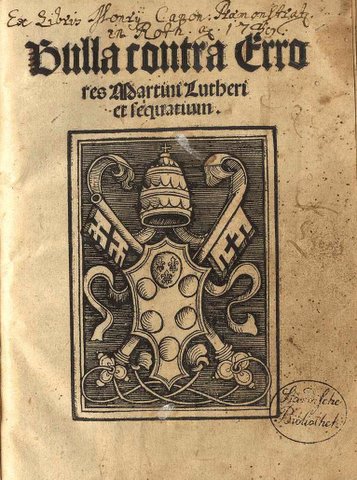
  • Papal Bull Condemning Martin Luther, Pope Leo X, 1520.
  • Papal Bull Condemning Martin Luther, Pope Adrian VI, 1523.
  • a 1525 indulgence
  • 1522 Erasmus' Commentary on his Latin paraphrase of the NT
  • 1516 Erasmus Greek NT (the one that was rushed to print)
  • 1521 Erasmus Greek NT
  • Complutensian Polyglot, Vol IV, NT (whose typeface begat some of our modern Greek PC fonts)
  • 1525 Daniel Bomberg Pentateuch (Hebrew text including Aramaic targum and Rabbinic commentary)
  • Martin Luther NT 1524 illustrated/painted/gilded
  • Tyndale Pentateuch 1530
  • Tyndale NT 1536
  • Coverdale Bible 1535
  • Coverdale NT English/Latin 1538
  • Taverner (Coverdale revision) 1539
  • Geneva NT 1557
  • Geneva Bible 1560
  • "Bishop's Bible" 1568
  • Rheims NT 1582
  • 1611 1st edition KJV
  • relief book cover by Salvador 
    Dali (click on photo to enlarge)
  • several KJV folio editions
  • Stephanus Greek NT 1551
  • multiple KJVs from 1600s
  • "Wife Beater" Bible 1551
  • "Child Killer" Bible 1795
  • "Wicked Bible" 1631
  • "Vinegar Bible" 1717
  • multiple illustrated and engraved Bibles.
  • 10th cent. Greek Psalter from Constantinople
  • Psalterium Gallicannus Ferriatum (?) 1420
  • Illustrated Psalter, Master of Jacques de Besancon 1480
  • Speculum Humanae Salvationis, 1370, Tyrol
  • Metal relief book cover by Salvador Dali for Sigmund Freud's Moïse et Monothéisme

Wednesday, June 29, 2011

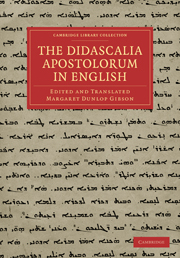
Didascalia Apostolorum: A Syriac text


A treatise claiming to have been written by the Apostles at the time of the Council of Jerusalem (Acts 15), but is really a composition of the third century. It was first published in 1854, in Syriac. The original was in Greek, and this can be to some extent restored by a comparison with the Apostolic Constitutions. 

The contents are the same as those of the corresponding books of the Apostolic Constitutions. Especially noticeable is the treatment which bishops are ordered to give to penitents. The church officials are bishops, deacons, priests, widows (and orphans); deaconesses are also added, in one place rectors, and once subdeacons. These last may have been interpolated.

The place of composition was Syria, though what part cannot be determined. The author was apparently a canonical bishop. It never touches upon dogma but concerns itself entirely with practice. It has been called the earliest attempt at a corpus of canon law. - from the Catholic Encyclopedia Online  (http://www.newadvent.org/cathen/04781b.htm)

According to Dr. Charlotte Fonrobert (Stanford University), the Syriac translation reveals a Jewish character and a diversity of Jewish heterodox practices consistent with the rabbinic tradition. Fonrobert suggests that "the Didascalia can be read as a counter-Mishnah for the disciples of Jesus."

In addition, the text supports the theory that even in the fourth century, rabbinic Judaism was still in the process of establishing itself as the representative form of Judaism. Simultaneously, the process of the separation between Judaism and Christianity still remained in flux. ("The Didascalia Apostolorum: A Mishnah for the Disciples of Jesus". Journal of Early Christian Studies, Volume 9, Number 4, Winter 2001, pp. 483-509).

A Syriac version in Serto (from a German/Latin edition) can be downloaded from Archive.org here:

A Syriac version in Estrangelo (from the (Gibson, 1903 English edition) can be downloaded from Archive.org here: http://www.archive.org/details/didascaliaapost00gibsgoog

Its English translation (Gibson, 1903) can be downloaded from Archive.org here: http://www.archive.org/details/didascaliaaposto00gibsuoft

Kevin Edgcombe's online English scanned from the Connolly translation (R. Hugh Connolly, Didascalia Apostolorum. Oxford: Clarendon Press, 1929.) Mr. Edgcombe has added notations to readily identify Scriptural and other citations. It can be read online here: http://www.bombaxo.com/didascalia.html

Side by side Greek and Latin text can be downloaded from Archive.org here: http://www.archive.org/details/didascaliaetcon00funkgoog