Image for banner reproduced by permission from the President and Fellows of Queens' College, Cambridge. [Psalm 23 in Syriac. Psalmi Davidis, edited by Thomas van Erpe (Leiden 1625)]
Showing posts with label texts. Show all posts

Saturday, October 29, 2016

Online Resources for Learning and Practicing

LEARNING

DARIUS Online learning Platform, Steve Caruso
Well designed online modules for Classical Syriac/Aramaic
http://darius.rogueleaf.com/

Lessons for Surayt/Turoyo dialect, Freie Universität Berlin
http://surayt.com/

Biblical Aramaic
Online PDFs of "Introductory Lessons in Aramaic" by Eric D. Reymond, Yale/UMich
http://www.introlessonsinaramaic.com/

Beith Souryoyé Morounoyé
Series of PDF documents, Maronite
http://www.beith-morounoye.org/syriac/index1.html

Elementary Western Syriac letter and word descriptions.Little to no grammar instruction.
http://www.syriacstudies.com/category/learn-syriac/

DIGITIZED MANUSCRIPTS & MODERN PRAYER SOURCES

Digitized Manuscripts online
https://www.vhmml.org/readingRoom/

Online Syriac verse and English translation
https://thehiddenpearl.org/

Sh'heemo, Daily prayers of the week, PDFs
http://www.soc-wus.org/worship/prayer.htm

Maronite daily prayers
http://www.maronitefaith.com/maronite-library/

Includes prayers, verse, and explanation of liturgical terms
by anonymous
http://www.qadishat.com/

Online modern Prayer book, Malankara Syriac Orthodox use
https://sites.google.com/site/syrianorthodox/praying-the-shimo

Thursday, September 1, 2016

vHMML's new online Lectorium

From the vHMML website:

The
Hill Museum & Manuscript Library is happy to announce the launch of the vHMML Reading Room, which provides access to complete digitized manuscripts and improved cataloging

You can find vHMML Reading Room here: https://www.vhmml.org/readingRoom/

Full access to Reading Room requires a one-time, no-cost, registration. Once your registration has been approved, you'll be able to use Reading Room freely. On the Reading Room landing page you'll see information about which collections have already been uploaded; for others you'll need to use our legacy catalog or consult the list of uncataloged collections accessible from the Reading Room landing page.

Saturday, July 23, 2016

vHMML Syriac paleography

Hill Museum & Manuscript Library's vHMML SCHOOL offers lessons in paleography, codicology, and transcription. FOLIO provides annotated manuscript pages for study and practice in transcription.

https://www.vhmml.org/school

Thursday, July 30, 2015

Gorgias Open: Download books for free

Gorgias Press has launched a new initiative called Gorgias Open, where select books will be made available for free.

Especially interesting is: Salvation in Christ According to Jacob of Serugh: An Exegetico-theological Study on the Homilies of Jacob of Serugh on the Feasts of Our Lord by Thomas Kollamparampil

Download from here:
http://gorgiaspress.com/bookshop/t-openaccess_repository.aspx


Saturday, July 23, 2011

I beheld the Codex Climaci Rescriptus with mine own eyes

As most of the Biblioverse knows, the Codex Climaci Rescriptus was purchased by Steven Green, owner of Hobby Lobby, and placed within a larger collection entitled Passages which is currently on the first leg of its tour in Oklahoma City.

I am not sure what I expected, but I thought perhaps I would see the codex highlighted and surrounded by a few other items shown on the Passages website.  This was not the case. Whether by lack of marketing were whether by intentional understatement, the extent and quality of the collection is both surprising and overwhelming to the degree that the Codex Climaci Rescriptus is almost swallowed up.

The one weakness of this exhibit is that there was no master list of display items. Had this been available I think the collection would have made a bigger splash; not necessarily for you academic types, but moreso for local pastors and knowledgable lay people who are aware of manuscript, translation, and printing history but have seen historical items only as photos in textbooks or on the internet. It is wonderful to find a high resolution scan of an ancient codex, but it is another thing altogether to read words on the living page.

In the absence of an official exhibit list, I offer here my own incomplete and hastily written list of items on display at the Passages exhibit. Judge for yourself whether the Codex Climaci has found a worthy home. But be aware, my list represents only about a third of the actual exhibit...

"Evanis" Gospel illumination
  • Circular menorah hewn from a single stone. Most likely used in the 2nd temple, according to the display.
  • Multiple medieval Torah scrolls- Yemenite, Sephardic
  • Dead Sea Scroll fragment (was not able to get detail, maybe later)
  • Bodmer papyrus XXIV
  • Evanis Gospels, Greek, c. 1000.( illuminated on parchment. One of the earliest and smallest examples of calligraphic minuscule.)
  • Multiple Greek papyri- 2nd-5th centuries
  • Codex Climaci Rescriptus- only two leaves on display, one showing the underlying Greek text (with a handwritten "5" in the corner), the other showing the CPA palimpsest (the rest of the Codex is stored off site, in the possession of the Green family).

"St. Cecilia" Latin Bible
  • van Hattem Bible (Latin)
  • St. Cecilia Bible (Latin)
  • Several Vulgates from 1200s (handwritten margin notes in Latin visible :) )
  • Greek parchment "Letter from Theon", 3rd cent.
  • Coptic papyrus Psalms 112 (111 in Protestant/Masoretic reckoning), 4th cent.

  • Khabouris Codex, (open to show the Acts of the Apostles, ch 3) 11th cent.
  • Multiple medieval French and German Bibles & prayer books
  • Rosebery Rolle Bible
  • Anglo Saxon printed gospels 1573
  • Conveyance document (transfer of property title), signed by John Wycliffe's brother Robert and including his seal. 1393
  • 1454 Gutenberg "noble fragment" of Romans
    The Anti-Christ and 15 Signs of the Doomsday
  •  1462 Gutenberg Bible printed by apprentice Peter Schöffer, 1 of 4 surviving copies.
  • 1480 Latin Bible with papal seal, taken by Napoleon
  • The Anti-Christ and 15 Signs of the Doomsday (Der Antichrist und die fünfzehn Zeichen). Block-book. Nuremberg: Hans Sporer, 1470. Only surviving copy.


  • 1493 Nuremberg Chronicle
  • 1470 edition of "Antiquity of Jews and the Jewish Wars" by Josephus (Latin)
  • 1471 edition of "Postilla Litteralis super Bibliam" by Nicholas de Lyna
  • 1476 Venetian edition of "Summa Contra Gentiles" by Thomas Acquinas
  • "The Imitation of Christ" by Thomas a Kempis, 1st edition. c 1418.
  • Genoa Polyglot Psalms, 1516 (Greek, Aramaic, Hebrew, Latin, Arabic). Psalm 19 includes a margin reference to Christopher Columbus's voyage to the New World and the prophetic character the Gospel being carried around the world:  Et in fines mundi verba eorum, Saltem teporibus nostris ... mirabili ausu Christophori Columbi  genuensis, alter pene orbis repertus est christianoremus cetui aggregatus.

  • Johannes Frobens "Poor Man's Bible" 1491 (Latin)
  • Last Will and Testament, Martin Luther, Oct. 1518.
  • "Babylonian Captivity of the Church" by Martin Luther, 1520.
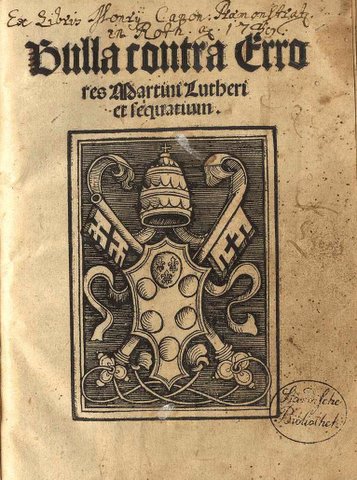
  • Papal Bull Condemning Martin Luther, Pope Leo X, 1520.
  • Papal Bull Condemning Martin Luther, Pope Adrian VI, 1523.
  • a 1525 indulgence
  • 1522 Erasmus' Commentary on his Latin paraphrase of the NT
  • 1516 Erasmus Greek NT (the one that was rushed to print)
  • 1521 Erasmus Greek NT
  • Complutensian Polyglot, Vol IV, NT (whose typeface begat some of our modern Greek PC fonts)
  • 1525 Daniel Bomberg Pentateuch (Hebrew text including Aramaic targum and Rabbinic commentary)
  • Martin Luther NT 1524 illustrated/painted/gilded
  • Tyndale Pentateuch 1530
  • Tyndale NT 1536
  • Coverdale Bible 1535
  • Coverdale NT English/Latin 1538
  • Taverner (Coverdale revision) 1539
  • Geneva NT 1557
  • Geneva Bible 1560
  • "Bishop's Bible" 1568
  • Rheims NT 1582
  • 1611 1st edition KJV
  • relief book cover by Salvador 
    Dali (click on photo to enlarge)
  • several KJV folio editions
  • Stephanus Greek NT 1551
  • multiple KJVs from 1600s
  • "Wife Beater" Bible 1551
  • "Child Killer" Bible 1795
  • "Wicked Bible" 1631
  • "Vinegar Bible" 1717
  • multiple illustrated and engraved Bibles.
  • 10th cent. Greek Psalter from Constantinople
  • Psalterium Gallicannus Ferriatum (?) 1420
  • Illustrated Psalter, Master of Jacques de Besancon 1480
  • Speculum Humanae Salvationis, 1370, Tyrol
  • Metal relief book cover by Salvador Dali for Sigmund Freud's Moïse et Monothéisme

Tuesday, July 5, 2011

New Testament Textual Criticism: The Case For Byzantine Priority


From the beginning of the modern critical era in the nineteenth century the Byzantine Textform has had a questionable reputation. Associated as it was with the faulty Textus Receptus editions which stemmed from Erasmus’ or Ximenes’ uncritical selection of a small number of late manuscripts (hereafter MSS), scholars in general have tended to label the Byzantine form of text “late and secondary,” due both to the relative age of the extant witnesses which provide the majority of its known support and to the internal quality of its readings as subjectively perceived. Yet even though the numerical base of the Byzantine Textform rests primarily among the late minuscules and uncials of the ninth century and later, the antiquity of that text reaches at least as far back as its predecessor exemplars of the late fourth and early fifth century...

The article was originally published online by SBL's TC: A Journal of Biblical Textual Criticism. The 1st Part can be read on the Preachers' Institute site here.

From Part II:
If a legitimate critique can be made against the Byzantine Textform because early witnesses fail to reflect its specific pattern of readings, the current eclectic models (regardless of edition) can be criticized more severely, since their resultant texts demonstrate a pattern of readings even less attested among the extant witnesses. Read Part II here.

Part III here...

Wednesday, June 29, 2011

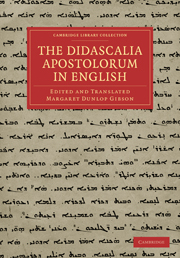
Didascalia Apostolorum: A Syriac text


A treatise claiming to have been written by the Apostles at the time of the Council of Jerusalem (Acts 15), but is really a composition of the third century. It was first published in 1854, in Syriac. The original was in Greek, and this can be to some extent restored by a comparison with the Apostolic Constitutions. 

The contents are the same as those of the corresponding books of the Apostolic Constitutions. Especially noticeable is the treatment which bishops are ordered to give to penitents. The church officials are bishops, deacons, priests, widows (and orphans); deaconesses are also added, in one place rectors, and once subdeacons. These last may have been interpolated.

The place of composition was Syria, though what part cannot be determined. The author was apparently a canonical bishop. It never touches upon dogma but concerns itself entirely with practice. It has been called the earliest attempt at a corpus of canon law. - from the Catholic Encyclopedia Online  (http://www.newadvent.org/cathen/04781b.htm)

According to Dr. Charlotte Fonrobert (Stanford University), the Syriac translation reveals a Jewish character and a diversity of Jewish heterodox practices consistent with the rabbinic tradition. Fonrobert suggests that "the Didascalia can be read as a counter-Mishnah for the disciples of Jesus."

In addition, the text supports the theory that even in the fourth century, rabbinic Judaism was still in the process of establishing itself as the representative form of Judaism. Simultaneously, the process of the separation between Judaism and Christianity still remained in flux. ("The Didascalia Apostolorum: A Mishnah for the Disciples of Jesus". Journal of Early Christian Studies, Volume 9, Number 4, Winter 2001, pp. 483-509).

A Syriac version in Serto (from a German/Latin edition) can be downloaded from Archive.org here:

A Syriac version in Estrangelo (from the (Gibson, 1903 English edition) can be downloaded from Archive.org here: http://www.archive.org/details/didascaliaapost00gibsgoog

Its English translation (Gibson, 1903) can be downloaded from Archive.org here: http://www.archive.org/details/didascaliaaposto00gibsuoft

Kevin Edgcombe's online English scanned from the Connolly translation (R. Hugh Connolly, Didascalia Apostolorum. Oxford: Clarendon Press, 1929.) Mr. Edgcombe has added notations to readily identify Scriptural and other citations. It can be read online here: http://www.bombaxo.com/didascalia.html

Side by side Greek and Latin text can be downloaded from Archive.org here: http://www.archive.org/details/didascaliaetcon00funkgoog

Update on the Codex Climaci Rescriptus


If you like old books- I mean reeeaallly old books- you might remember that last year Westminster College in Cambridge, England auctioned off the Codex Climaci Rescriptus with the help of Sotheby's. I first read the news on Steve Caruso's Aramaic Blog (his post here). The announcement on Forbes can be viewed here. And I posted a frustrated note here.

Just as a reminder, the Codex is a 6th century document and an important manuscript witness to the Greek text of the Gospels. It includes the Palestinian Aramaic Old and New Testament and a Syriac copy of writings by St. John Climacus, one of the most important spiritual authors in the Eastern Church. It is thought by some that the Syriac translation was copied directly from the saint's autograph. Based on the combination of languages (Greek/Syriac/CPA) and its original home (St. Catherines monastery on Mt. Sinai), someone could assume the Codex originates from within the Antiochian patrimony.

Word quickly spread around the blogosphere and academic circles were afraid the lucky buyer would simply separate the leaves and resell them individually to wealthy dilettantes looking to impress their friends with historic wall hangings. You can see a discussion of the Codex at the Hugoye Syriac Studies group here.

Here is the update: Just last week I just came across this online article. Here are some excerpts:

Leaders of the Oklahoma-owned Hobby Lobby retail chain have acquired hundreds of Bible artifacts and are helping to open a museum. Portions of the Codex Climaci Rescriptus, one of the earliest near-complete Bibles, will be featured in the National Bible Museum...

The museum is a nonprofit organization co-founded by historian Scott Carroll, a [former] professor at Cornerstone University in Michigan, along with D. Jonathan Shipman and Daniel Centurione...

Carroll said Wednesday the museum collections will include one of the earliest-known, near-complete Bibles, recently acquired by Hobby Lobby. He said items destined for the museum are being housed in Oklahoma City...

He said Hobby Lobby recently acquired several items for the museum, including portions of the Codex Climaci Rescriptus, which he said is one of the earliest near-complete Bibles in the world.

("Oklahomans help acquire items for Bible museum" BY CARLA HINTON Oklahoman, Published: April 1, 2010)

Notice the article is several months old yet I am just now finding it. So the Codex Climaci Rescriptus is being safely kept somewhere within my home town, Oklahoma City. This relic and icon of the ancient church sits within a small radius of where I now sit, waiting for a museum to be built. I am tempted to go poking around local warehouses. I think of the final scene from Raiders of the Lost Ark

How would someone go about pulling the right strings so that people could view the this Codex? There is a handful of local academics, clergy, and readers of Greek and Syriac that would love to see it.