- The differences between, importance, and uses of Classical Syriac, Christian Palestinian Aramaic, and Old Galilean. Who used them, where, and what kinds of things were written in each? Out of these languages, what writings were important to the continuity / discussion of Xian theology? Important as early Xian witnesses? To the defense of the Scriptures?
- Syriac theological terms whose uses/meanings have changed over the centuries requiring adjustments in scripture translations. Cases (from scripture or poetry translations) where Syriac words were changed in order to *retain* original theological meanings.
- Vocabulary study: Greek *theological* loan words in Syriac. Why were existing Syriac terms insufficient? Examples of archaic Syriac phrases that were replaced with Greek. Did this happen in scripture translations?
- How Syriac poetic embellishments on the life of Biblical figures (from Jacob Serug, Ephraim, etc) were used to support/defend Scripture and theological/Christological concepts.

Thursday, May 20, 2021
Ideas for Syriac class topics. If you teach these, I will take your class.

Sunday, May 16, 2021
Tuesday, October 1, 2019
Revealing, Preserving, and Sharing the Syriac Manuscript Heritage in the Near East and India
Discovering a New World in the Old: Revealing, Preserving, and Sharing the Syriac Manuscript Heritage
in the Near East and India

By
Fr. Columba Stewart, OSB, DPhil, Hill Museum & Manuscript Library
On
the occasion of the appearance of the fifteenth volume of the edition
of the Peshitta, the second-century Syriac Bible still used by Syriac
Christians in the Middle East and the Diaspora. This is the first volume
prepared in Amsterdam after the move of the Peshitta Institute from
Leiden.
Since 2003 the
Hill Museum & Manuscript Library
(HMML) at Saint John’s University, Collegeville, Minnesota, has been
partnering with Syriac-tradition communities throughout the Near East
and South India to digitize, catalog, and share their manuscript
heritage. HMML’s work with Syriac manuscripts is part
of a broader effort that began on the eve of the US-led invasion of
Iraq and continued throughout subsequent tragedies, particularly the
rise of Daesh (ISIS) in 2014, when Christians were uprooted from Mosul
and villages throughout the Nineveh plain.
The
result has been the digitization of more than 15,000 Syriac and
Garshuni manuscripts from five countries (India,
Iraq, Lebanon, Syria, Turkey) and the Old City of Jerusalem. These
include manuscripts from the Chaldean Catholic, Malankara Orthodox,
Maronite, Syriac Catholic, Syriac Orthodox, Syro-Malabar Catholic and
Syro-Malankara Catholic traditions. Together these
represent a largely unstudied array of manuscript material
complementing the well-known collections in Europe and North America.
Most of these manuscripts were previously inaccessible to scholars. In
recent years some collections have been moved or hidden
because of war, while others have been destroyed. Complete digital
versions are now coming online through vHMML Reading Room, with more
than 4000 Syriac manuscripts already freely accessible, including scans
of almost 50 manuscripts from the microfilm collection
of the Peshitta Institute.

The
lecture will be followed by short talks on the new Brill Peshitta Portal (Wido van Peursen) and the on the 60th
anniversary of the Peshitta Institute (Bas ter Haar Romeny). After
these, the new volume will be presented to H.E. Mor Polycarpus,
Metropolitan
and Patriarchal Vicar for the Netherlands of the Syriac Orthodox
Church, and Fr. Columba Stewart. The meeting will be concluded by a
drinks reception.
15
October 2019, 3 p.m., room Agora 1 (third floor, main building), Vrije
Universiteit Amsterdam, De Boelelaan 1105, 1081 HV Amsterdam
Registration (optional):
bas.ter.haarromeny@vu.nl
Tuesday, February 5, 2019
Lenten Prayer of Saint Ephrem translated into Syriac by Ninos Oshaana
Reposted here for posterity from his Wordpress blog (https://oshaana.wordpress.com/)...
"Every year during Great Lent, Orthodox Christians recite a short yet deeply poignant prayer attributed to Saint Ephrem the Syrian.
Working from the English text, I translated the prayer back into Syriac. Please note that this is only an approximation of how the prayer would be written in Syriac and not the actual text by Saint Ephrem. I have also transliterated the Syriac text to demonstrate the pronunciation."

"Every year during Great Lent, Orthodox Christians recite a short yet deeply poignant prayer attributed to Saint Ephrem the Syrian.
O Lord and Master of my life! Take from me the spirit of sloth, faint-heartedness, lust of power, and idle talk. But give rather the spirit of chastity, humility, patience, and love to Thy servant. Yea, O Lord and King! Grant me to see my own errors and not to judge my brother; For Thou art blessed unto ages of ages. AmenFriends and colleagues have asked if I know the original Syriac version of this prayer. I’m assuming it exists somewhere although I personally have not seen any references to a Syriac manuscript which contains the prayer in this form. Many of Saint Ephrem’s prayers have similar wording and structure. The attribution to Saint Ephrem is also very old.
Working from the English text, I translated the prayer back into Syriac. Please note that this is only an approximation of how the prayer would be written in Syriac and not the actual text by Saint Ephrem. I have also transliterated the Syriac text to demonstrate the pronunciation."
Saturday, December 29, 2018
Targum: Translation And Transmission
A new 2018-19 series of articles shared on the roots and the prospects that unite Eastern and Oriental Orthodox Traditions to the realm of Jewishness and Hassidism, Compared semantics and exegetical “paysages” by archpriest Alexander A.Winogradsky Frenkel (Patriarchate of Jerusalem). Below the tenth article...
"...Nowadays, the Yemenite Jewish communities are the only ones that systematically read the weekly portions in Hebrew, then in Aramaic in the targum of Onkelos the proselyte and finally in Arabic, i.e. the vernacular tongue. This method of translating/interpreting can lead to complete estrangement, a process that drifts away from the basic meaning of the sacred texts."
"...Nowadays, the Yemenite Jewish communities are the only ones that systematically read the weekly portions in Hebrew, then in Aramaic in the targum of Onkelos the proselyte and finally in Arabic, i.e. the vernacular tongue. This method of translating/interpreting can lead to complete estrangement, a process that drifts away from the basic meaning of the sacred texts."
Saturday, June 16, 2018
Found: Greek fragments of the First Apocalypse of James

only a small number of texts from the Nag Hammadi library — a collection of 13 Coptic Gnostic books discovered in 1945 in Upper Egypt — have been found in Greek, their original language of composition. But earlier this year, UT Austin religious studies scholars Geoffrey Smith and Brent Landau added to the list with their discovery of several fifth- or sixth-century Greek fragments of the First Apocalypse of James, which was thought to have been preserved only in its Coptic translations until now.
“To say that we were excited once we realized what we’d found is an understatement,” said Smith, an assistant professor of religious studies. “We never suspected that Greek fragments of the First Apocalypse of James survived from antiquity. But there they were, right in front of us.”
The ancient narrative describes the secret teachings of Jesus to his brother James, in which Jesus reveals information about the heavenly realm and future events, including James’ inevitable death.
https://news.utexas.edu/2017/11/29/ut-austin-professors-discover-copy-of-jesus-secret-teaching
http://spectrumlocalnews.com/tx/austin/news/2017/11/30/ut-professors-discover-unknown-jesus-gospels
Saturday, May 26, 2018
NEW: The Digital Syriac Corpus

Individual texts may be downloaded to facilitate publishing projects, such as the production of critical editions, and research, such as more advanced corpus linguistic analysis.
John Ma: The Maccabees and Religious Persecution
Dr. John Ma of Columbia University discusses religious persecution and the accounts of the Maccabees.
Saturday, January 6, 2018
Galilean Aramaic Online Course BETA
Steve Caruso is still producing and still awesome.
http://aramaicnt.org/courses/aramaic/galilean/gal-101-beta/

New Galilean Aramaic Online Course BETA Open
http://aramaicnt.org/courses/aramaic/galilean/gal-101-beta/
Tuesday, October 10, 2017
Translation from the work of St Severus of Antioch
Translation from the work of St Severus of Antioch by Father Peter Farrington
http://www.stgeorgeministry.com/category/translations/


Friday, February 24, 2017
Zondervan Online Courses

Aramaic...
https://courses.zondervanacademic.com/all/biblical-aramaic
Syriac...
https://courses.zondervanacademic.com/all/classical-syriac
The rest (Greek, Hebrew, theology, history, etc)...
https://courses.zondervanacademic.com/all
Saturday, February 4, 2017
Codex Climaci Rescriptus- Now being studied up close

In 2016 MOTB asked CSART to take the lead in studying, editing, and publishing the Syriac text of the topmost layer—the Ladder of Divine Ascent of John Climacus.
https://blogs.acu.edu/csart/projects/codex-climaci-rescriptus/

Saturday, January 28, 2017
Digitized Manuscript Collections
Digitizing Syriac Manuscripts Intro
Vatican Library Digitized Collections
http://digi.vatlib.it/
Hill Museum and Manuscripts Library
https://www.vhmml.org/
BYU Syriac Studies Reference Library
https://lib.byu.edu/collections/syriac-studies-reference-library/
Medieval Manuscripts at Houghton Library, Harvard
http://hcl.harvard.edu/libraries/houghton/collections/early_manuscripts/bibliographies/Syriac.cfm
Goussen library collection, Universität Bonn
http://digitale-sammlungen.ulb.uni-bonn.de/ulbbn/nav/classification/16431
British Library
http://www.bl.uk/manuscripts/Default.aspx
Monday, December 12, 2016
Two excellent blogs
Note to self:
Two excellent blogs that I need to put into my reading rotation...
https://thehiddenpearl.org/tag/syriac/
http://www.qadishat.com/
and a Maronite website to read through :
http://www.beith-morounoye.org/prayers/index2.html
Two excellent blogs that I need to put into my reading rotation...
https://thehiddenpearl.org/tag/syriac/
http://www.qadishat.com/
and a Maronite website to read through :
http://www.beith-morounoye.org/prayers/index2.html
Thursday, December 1, 2016
The Myth of the Pagan Origins of Christmas

The most detailed study of this is by Thomas Schmidt at Yale. As a scholar of ancient Greek he takes into account pre-Christian writers. Look in Academia.edu and Vigiliae Christianae
http://www.intellectualtakeout.org/blog/myth-pagan-origins-christmas
Hippolytus in 202-211 AD set the date for the birth of Jesus on December 25, because he thought Jesus was conceived 9 months earlier on the Passover, the day in which he also thought the world was created (5500 years earlier), the Vernal Equinox March 25. Clement of Alexandria (193-215 AD) quoted various anonymous sources about the birth of Jesus and roughly agrees with Hippolytus, claiming that Jesus was born in late fall to early winter. Clement’s sources clearly seem to believe that Jesus was conceived on the Passover and was born roughly 9 months later; in fact the only difference between them and Hippolytus is that they differed on when the Passover actually occurred.
-by Tom Schmidt “Sol Invictus evidently not a precursor to Christmas” Chronicon Blog, December 21, 2010. (http://chronicon.net/blog/christmas/sol-invictus- evidently-not- a-precursor- to-christmas)
The following is from "Calculating Christmas” Touchstone Magazine, by William J. Tighe, Associate Professor of History, Muhlenberg College, Allentown, Pennsylvania:
As things actually happened, Aurelian, who ruled from 270 until his assassination in 275, was hostile to Christianity and appears to have promoted the establishment of the festival of the “Birth of the Unconquered Sun” as a device to unify the various pagan cults of the Roman Empire around a commemoration of the annual “rebirth” of the sun.
...the early Church followed [the Gospel of] John rather than the Synoptics, and thus believed that Christ’s death would have taken place on 14 Nisan, according to the Jewish lunar calendar. Greek Christians seem to have wanted to find a date equivalent to 14 Nisan in their own solar calendar... they chose the 14th day of Artemision [equivalent to April 6th on the Roman calendar]. In contrast, second-century Latin Christians in Rome and North Africa... concluded that he died on Friday, 25 March 29. So in the East we have April 6th, in the West, March 25th.
At this point, we have to introduce a belief that seems to have been widespread in Judaism at the time of Christ, but which, as it is nowhere taught in the Bible, has completely fallen from the awareness of Christians. The idea is that of the “integral age” of the great Jewish prophets: the idea that the prophets of Israel died on the same dates as their birth or conception.
The early Christians applied this idea to Jesus, so that March 25th and April 6th were not only the supposed dates of Christ’s death, but of his conception or birth as well...
What is the length of pregnancy? Nine months. Add nine months to March 25th and you get December 25th; add it to April 6th and you get January 6th. December 25th is Christmas, and January 6th is Epiphany.
Christmas (December 25th) is a feast of Western Christian origin. In Constantinople it appears to have been introduced in 379 or 380. From a sermon of St. John Chrysostom, at the time a renowned ascetic and preacher in his native Antioch, it appears that the feast was first celebrated there on 25 December 386. From these centers it spread throughout the Christian East, being adopted in Alexandria around 432 and in Jerusalem a century or more later.
Thus, December 25th as the date of the Christ’s birth appears to owe nothing whatsoever to pagan influences upon the practice of the Church during or after Constantine’s time.
Tuesday, November 22, 2016
Justin Sinaites at Abilene Christian University

More photos of Fr. Justin and the event can be viewed on Facebook
Monday, November 14, 2016
Outsiders or Insiders? The Changing Fortunes of Syrian Christians

 Dr. Christian Sahner is a historian of the Middle East and a Research Fellow at St John’s College, University of Cambridge. His work deals with the transition from late antiquity to the early Islamic period, relations between Muslims and non-Muslims (especially Christians and Zoroastrians), and the history of Syria. Born in New York City, he received an AB in Art and Archaeology from Princeton University, an M.Phil in Late Antique and Byzantine Studies from the University of Oxford, where he studied as a Rhodes Scholar, and a Ph.D. in History also from Princeton. He is the author of Among the Ruins: Syria Past and Present (Oxford/Hurst, 2014), a blend of history and memoir from his time in the Levant. He is currently at work on a second book which explores the little known Christian martyrs of the early Islamic period.
  It examines episodes of conversion, apostasy, and blasphemy as a way of understanding how an Islamic society first arose amidst the predominantly Christian population of the Middle East and Spain in the early centuries after the Arab conquests.
Saturday, October 29, 2016
Online Resources for Learning and Practicing
LEARNING

Well designed online modules for Classical Syriac/Aramaic
http://darius.rogueleaf.com/
Lessons for Surayt/Turoyo dialect, Freie Universität Berlin
http://surayt.com/
Biblical Aramaic
Online PDFs of "Introductory Lessons in Aramaic" by Eric D. Reymond, Yale/UMich
http://www.introlessonsinaramaic.com/
Beith Souryoyé Morounoyé
Series of PDF documents, Maronite
http://www.beith-morounoye.org/syriac/index1.html

http://www.syriacstudies.com/category/learn-syriac/
DIGITIZED MANUSCRIPTS & MODERN PRAYER SOURCES
Digitized Manuscripts onlinehttps://www.vhmml.org/readingRoom/

https://thehiddenpearl.org/
Sh'heemo, Daily prayers of the week, PDFs
http://www.soc-wus.org/worship/prayer.htm
Maronite daily prayers
http://www.maronitefaith.com/maronite-library/
Includes prayers, verse, and explanation of liturgical terms
by anonymous
http://www.qadishat.com/
Online modern Prayer book, Malankara Syriac Orthodox use
https://sites.google.com/site/syrianorthodox/praying-the-shimo
Monday, October 10, 2016
"Symeon the Stylite and Syrian Monasticism" lecture at University of Oklahoma
The University of Oklahoma Department of Classics and Letters Lecture Series
 Dina Boero (Princeton), Tuesday October 25
Boero holds a MA and PhD in Classics from the University of Southern California. Her research focuses saints and their cults in the late antique Near East, integrating literary, codicological, and archaeological sources. Her current book project, The Anatomy of a Cult, traces the history of Symeon the Stylite the Elder’s (d. 459) cult in the fifth and sixth centuries and by identifying the various transformations of veneration to Symeon, takes a step towards clarifying the origins of Syrian monasticism.


Boero holds a MA and PhD in Classics from the University of Southern California. Her research focuses saints and their cults in the late antique Near East, integrating literary, codicological, and archaeological sources. Her current book project, The Anatomy of a Cult, traces the history of Symeon the Stylite the Elder’s (d. 459) cult in the fifth and sixth centuries and by identifying the various transformations of veneration to Symeon, takes a step towards clarifying the origins of Syrian monasticism.


Thursday, September 15, 2016
Jack Tannous "Christians, Muslims, and the End of the Ancient World"
The University of Oklahoma Department of Classics and Letters Lecture Series
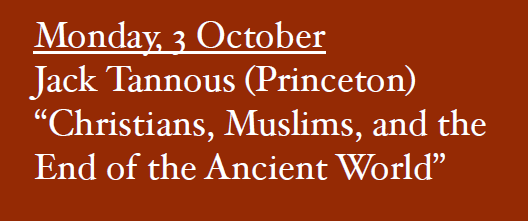 Jack Tannous, Monday, October 3
Tannouse's research and teaching focuses on the Syriac-speaking Christian communities of the Near East in in the Late Antique and early medieval period, as well as other aspects of Eastern Christian Studies and translation. Tannouse edited and translated the Syriac letters of George, Bishop of the Arab Tribes (d. 724)
Subscribe to:
Posts (Atom)